
Trois-Rivières Named Canada's Winter Sports Capital

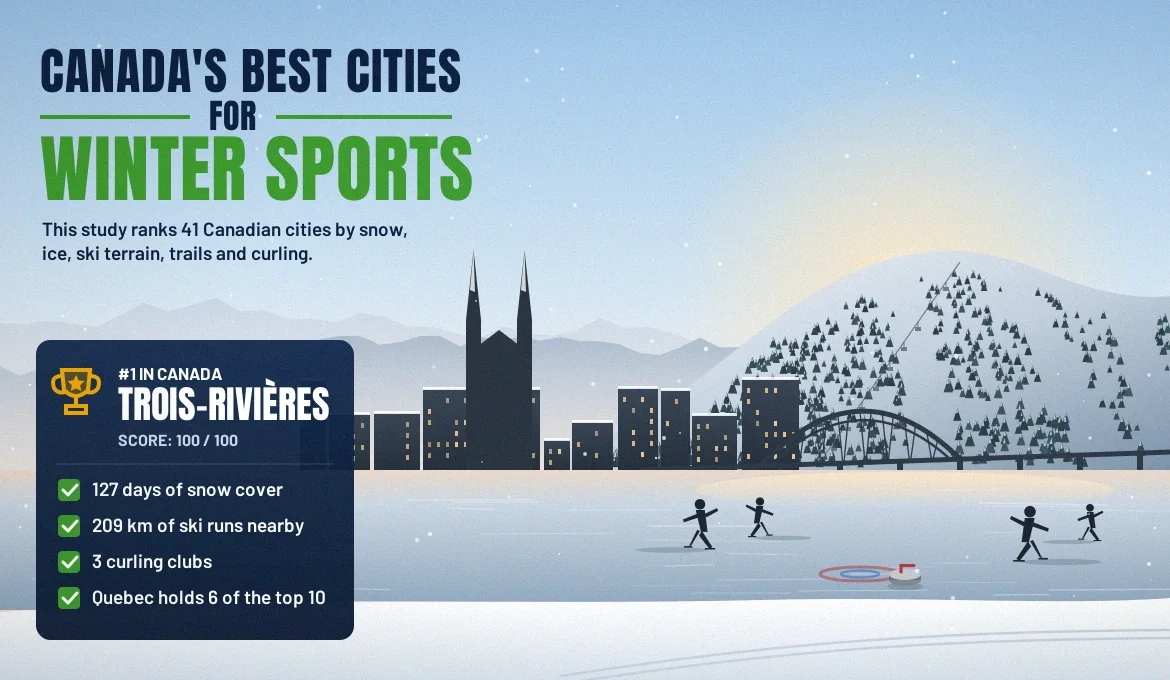
Illustration of a snowy riverside city with skaters and a curling stone on the frozen river and a ski hill behind, with the title Canada's Best Cities for Winter Sports and a card naming Trois-Rivières #1 in Canada
Quebec dominates
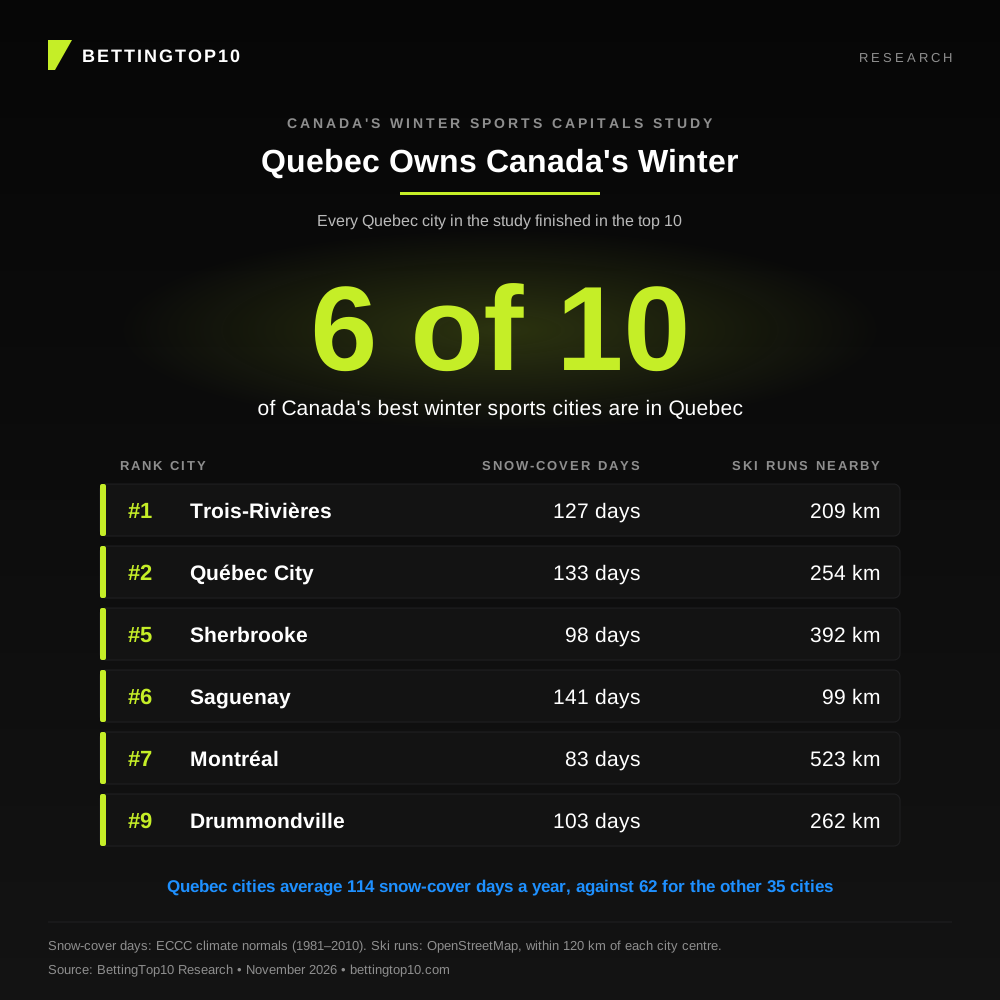
Six of the ten best winter sports cities in Canada are in la Belle Province, and the top two are both Quebec cities, separated by just over a point.
Trois-Rivières Named Canada's Winter Sports Capital
Trois-Rivières tops a new ranking of 41 Canadian cities for winter sports, and Quebec claims six of the top 10 spots.
By BettingTop10 CA Team · November 2026
The Bottom Line: Trois-Rivières is the best city in Canada for winter sports, scoring a perfect 100 out of 100, just ahead of Québec City (98.9). Quebec takes six of the top 10 places, and every Quebec city in the study made the cut.
Ask most Canadians where the country's winter sports capital is and you'll probably hear Whistler, Banff or maybe Montréal. But when you look at where people actually live, and at how much snow, ice, slope and trail they get on their doorstep, a different answer comes out on top: Trois-Rivières, a city of about 150,000 halfway between Montréal and Québec City.
We wanted to find out which Canadian cities make it easiest to get outside and enjoy winter, not just which ones have the biggest resorts nearby. So in a November 2026 study, BettingTop10 Canada ranked the core city of all 41 of Canada's metropolitan areas, from Toronto and Vancouver down to Belleville and Drummondville. Each one was scored on six things:
- How many days a year the snow stays on the ground
- How long the freeze lasts
- How often it gets bitterly cold
- How many kilometres of downhill runs sit within 120 km
- How many kilometres of groomed cross-country trails are within 50 km
- How many curling clubs there are for every 100,000 residents
The figures come from Environment and Climate Change Canada's 30-year climate records, OpenStreetMap ski data and Wikipedia's provincial curling club lists. Together, they add up to a single Winter Sports Score out of 100. It's the winter follow-up to our global ranking of the world's best cities for an active lifestyle.
At a Glance
- Quebec claims six of the top 10 spots, and all six Quebec cities in the study finished in the top 10: Trois-Rivières, Québec City, Sherbrooke, Saguenay, Montréal and Drummondville.
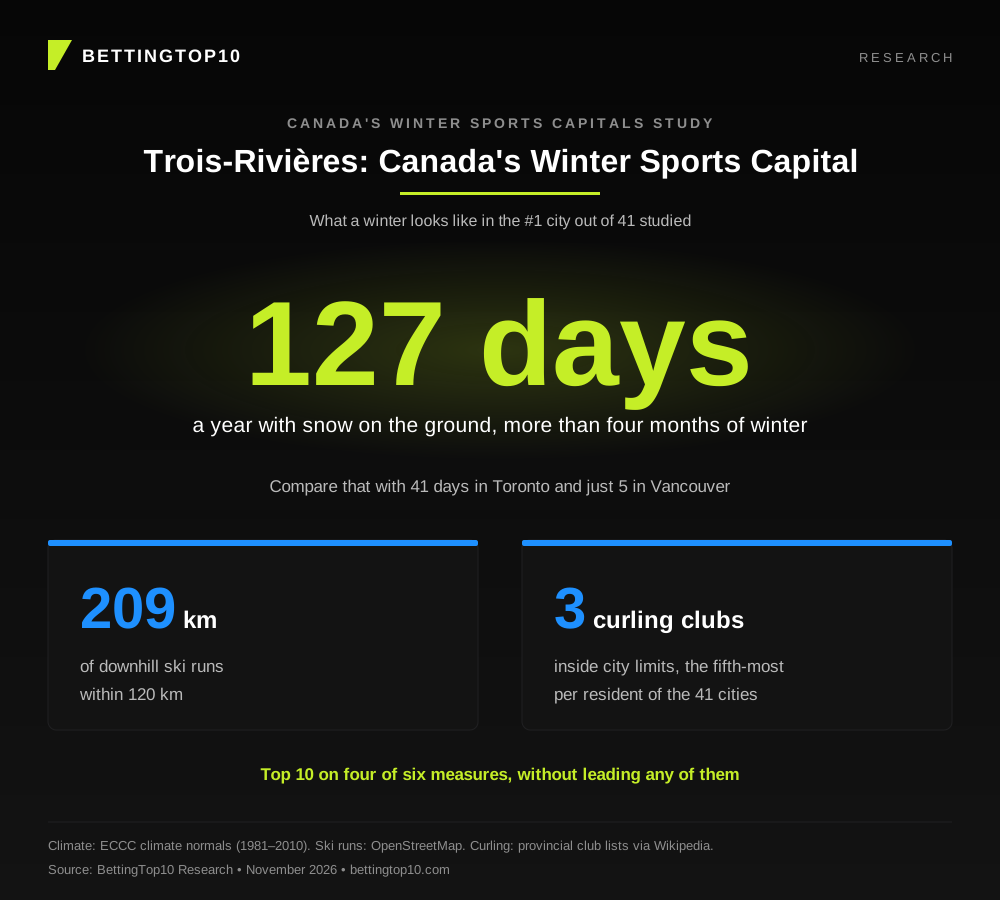
- Trois-Rivières wins without leading any single category. Its best result is fourth place, for snow cover (127 days a year)
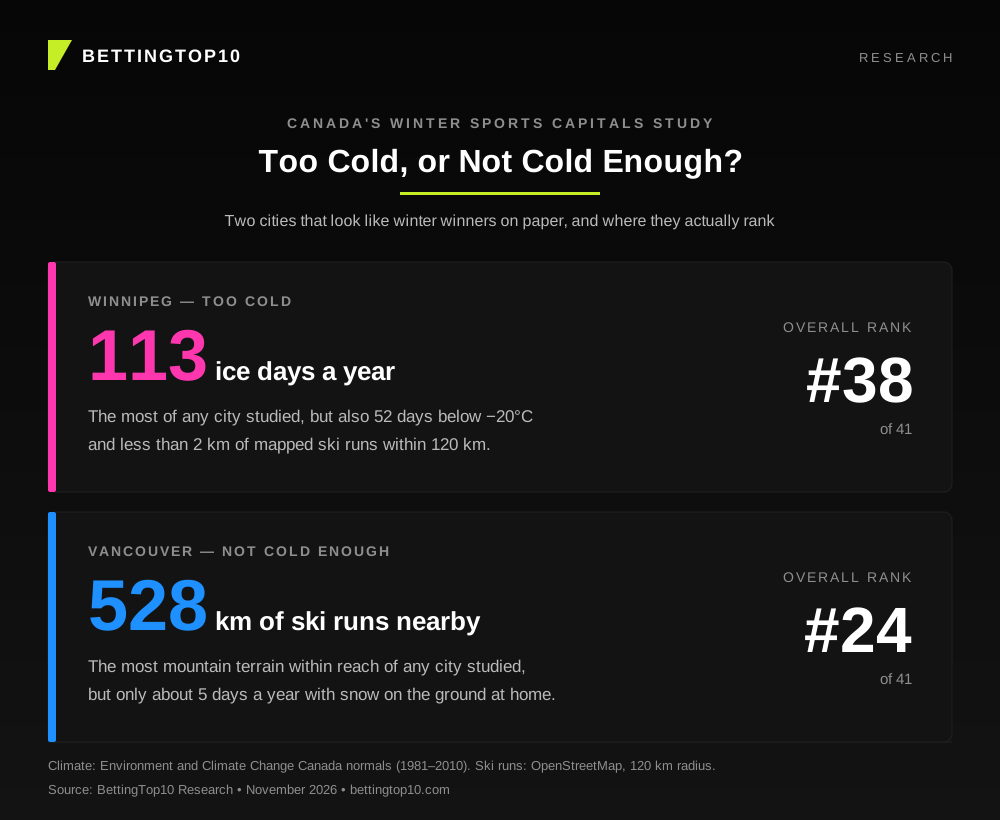
- Winnipeg has more ice days than any other city (113) but ranks just 38th, pulled down by 52 days a year below −20°C and almost no ski hills nearby
The Top 10 Cities for Winter Sports
|
Rank |
City |
Score |
Snow-cover days |
Ice days |
Days below −20°C |
Downhill runs within 120 km (km) |
Cross-country trails within 50 km (km) |
Curling clubs per 100k |
|
1 |
Trois-Rivières, QC |
100.0 |
127 |
88 |
27 |
209 |
59 |
2.0 |
|
2 |
Québec City, QC |
98.9 |
133 |
95 |
31 |
254 |
367 |
0.5 |
|
3 |
Ottawa, ON |
96.0 |
101 |
78 |
16 |
84 |
488 |
1.3 |
|
4 |
Thunder Bay, ON |
94.8 |
147 |
99 |
50 |
34 |
118 |
2.5 |
|
5 |
Sherbrooke, QC |
93.0 |
98 |
77 |
27 |
392 |
111 |
1.1 |
|
6 |
Saguenay, QC |
90.3 |
141 |
105 |
47 |
99 |
19 |
2.0 |
|
7 |
Montréal, QC |
90.0 |
83 |
74 |
19 |
523 |
237 |
0.1 |
|
8 |
Greater Sudbury, ON |
89.4 |
118 |
100 |
32 |
5 |
30 |
3.7 |
|
9 |
Drummondville, QC |
89.2 |
103 |
80 |
19 |
262 |
25 |
1.2 |
|
10 |
Kelowna, BC |
83.6 |
46 |
31 |
3 |
525 |
135 |
0.6 |
1
City
Trois-Rivières, QC
Score
100.0
Snow-cover days
127
Ice days
88
Days below −20°C
27
Downhill runs within 120 km (km)
209
Cross-country trails within 50 km (km)
59
Curling clubs per 100k
2.0
2
City
Québec City, QC
Score
98.9
Snow-cover days
133
Ice days
95
Days below −20°C
31
Downhill runs within 120 km (km)
254
Cross-country trails within 50 km (km)
367
Curling clubs per 100k
0.5
3
City
Ottawa, ON
Score
96.0
Snow-cover days
101
Ice days
78
Days below −20°C
16
Downhill runs within 120 km (km)
84
Cross-country trails within 50 km (km)
488
Curling clubs per 100k
1.3
4
City
Thunder Bay, ON
Score
94.8
Snow-cover days
147
Ice days
99
Days below −20°C
50
Downhill runs within 120 km (km)
34
Cross-country trails within 50 km (km)
118
Curling clubs per 100k
2.5
5
City
Sherbrooke, QC
Score
93.0
Snow-cover days
98
Ice days
77
Days below −20°C
27
Downhill runs within 120 km (km)
392
Cross-country trails within 50 km (km)
111
Curling clubs per 100k
1.1
6
City
Saguenay, QC
Score
90.3
Snow-cover days
141
Ice days
105
Days below −20°C
47
Downhill runs within 120 km (km)
99
Cross-country trails within 50 km (km)
19
Curling clubs per 100k
2.0
7
City
Montréal, QC
Score
90.0
Snow-cover days
83
Ice days
74
Days below −20°C
19
Downhill runs within 120 km (km)
523
Cross-country trails within 50 km (km)
237
Curling clubs per 100k
0.1
8
City
Greater Sudbury, ON
Score
89.4
Snow-cover days
118
Ice days
100
Days below −20°C
32
Downhill runs within 120 km (km)
5
Cross-country trails within 50 km (km)
30
Curling clubs per 100k
3.7
9
City
Drummondville, QC
Score
89.2
Snow-cover days
103
Ice days
80
Days below −20°C
19
Downhill runs within 120 km (km)
262
Cross-country trails within 50 km (km)
25
Curling clubs per 100k
1.2
10
City
Kelowna, BC
Score
83.6
Snow-cover days
46
Ice days
31
Days below −20°C
3
Downhill runs within 120 km (km)
525
Cross-country trails within 50 km (km)
135
Curling clubs per 100k
0.6
Top 3 Spotlight
1. Trois-Rivières, QC (100.0)
Trois-Rivières is Canada's winter sports capital. Snow covers the ground for 127 days a year, fourth-most of the 41 cities, and there are 209 km of mapped downhill runs within 120 km. Its 3 curling clubs give it the fifth-most per resident in the study. It ranks in the top 10 on four of the six measures and never lower than 13th on the five that reward winter activity, a consistency no other city matches.
2. Québec City, QC (98.9)
Québec City finishes just 1.1 points behind. It has the best ski access of the top three: 367 km of groomed cross-country trails within 50 km, second only to Ottawa, and 254 km of downhill runs within 120 km. Snow covers the ground for 133 days a year, third-most in the study. Curling is what costs it first place: 3 clubs for nearly 600,000 residents puts it 34th on that measure.
3. Ottawa, ON (96.0)
Ottawa is the top-ranked city outside Quebec. It has more groomed cross-country trails within 50 km than any other city, 488 km, and more curling clubs inside city limits, 15. It also has fewer bitter-cold days (16) than either city ahead of it. Downhill skiing holds it back: 84 km of mapped runs within 120 km ranks 20th.
Trois-Rivières doesn't top any single category, and that's exactly why it wins. It has four months of reliable snow, real ski hills within easy reach and a strong curling scene, without the extreme cold that keeps people indoors in some Prairie cities. The best winter sports city isn't the one with the biggest mountain or the coldest winter. It's the one where you can do a bit of everything
Jack Garry, Casino.com's Lead Analyst
Behind the Numbers
Quebec has the whole package. Every Quebec city in the study finished in the top 10, while Ontario, with 16 cities in the ranking, placed three (Ottawa, Thunder Bay and Greater Sudbury). The reason is the combination of snow and terrain. Quebec cities average 114 days a year with snow on the ground, almost twice the 62-day average of the other 35 cities, and nearly three times as much downhill terrain within 120 km (290 km on average, against 101 km). Montréal alone has 34 mapped ski areas within that radius, more than any other city studied.
No city wins every category, and the winner wins none. Thunder Bay leads for snow cover (147 days), Winnipeg for ice days (113), Vancouver for downhill terrain (528 km), Ottawa for cross-country trails (488 km) and Greater Sudbury for curling clubs per resident (3.7 per 100,000). Five B.C. cities tie for the fewest bitter-cold days, with none at all. Trois-Rivières tops none of them, and wins by staying near the top on almost everything.
Colder is not better. Winnipeg has the most ice days (113) and the most days below −20°C (52), and finishes 38th. Saskatoon (35th) and Regina (28th) follow the same pattern. All three cities have more than 40 bitter-cold days a year and less than 5 km of mapped downhill runs within 120 km.
Mountains aren't enough either. Vancouver has more mapped ski terrain within 120 km than any other city, 528 km, but sees only about 5 days a year with snow on the ground at home. It ranks 24th. Kelowna (10th) does far better because the snow reaches the valley too, with 46 snow-cover days.
Full Rankings
The study ranked all 41 of Canada's census metropolitan areas. Here is where the remaining 31 cities landed:
|
Rank |
City |
Score |
|
11 |
Edmonton, AB |
82.9 |
|
12 |
Barrie, ON |
82.3 |
|
13 |
Kamloops, BC |
81.4 |
|
14 |
Fredericton, NB |
81.1 |
|
15 |
Peterborough, ON |
77.7 |
|
16 |
Moncton, NB |
73.6 |
|
17 |
Red Deer, AB |
73.3 |
|
18 |
Saint John, NB |
72.7 |
|
19 |
Guelph, ON |
71.3 |
|
20 |
Calgary, AB |
71.0 |
|
21 |
Chilliwack, BC |
70.1 |
|
22 |
Kingston, ON |
68.3 |
|
23 |
Abbotsford, BC |
67.6 |
|
24 |
Vancouver, BC |
66.7 |
|
25 |
Brantford, ON |
63.9 |
|
26 |
Kitchener, ON |
63.7 |
|
27 |
Nanaimo, BC |
63.5 |
|
28 |
Regina, SK |
62.5 |
|
29 |
St. John's, NL |
62.0 |
|
30 |
St. Catharines, ON |
60.9 |
|
31 |
Oshawa, ON |
59.2 |
|
32 |
Hamilton, ON |
57.6 |
|
33 |
Toronto, ON |
55.9 |
|
34 |
Belleville, ON |
55.7 |
|
35 |
Saskatoon, SK |
55.3 |
|
36 |
Windsor, ON |
54.8 |
|
37 |
Halifax, NS |
54.4 |
|
38 |
Winnipeg, MB |
54.0 |
|
39 |
London, ON |
45.4 |
|
40 |
Victoria, BC |
44.9 |
|
41 |
Lethbridge, AB |
39.8 |
One More Thing
St. John's gets more snow than any other city in the study, 335 cm in an average year, yet ranks only 29th. There is no mapped ski area within 120 km of the city, and only 18 km of groomed cross-country trails within 50 km. Snowfall makes a winter, but it doesn't make a winter sports city on its own.
Metric Methodology
Each measure carries a different share of the final score. Downhill ski terrain counts the most, at almost a quarter of the total.
|
Metric |
Weighting |
|
Downhill ski runs within 120 km (km) |
23.5% |
|
Snow-cover days (snow depth of 5 cm or more) |
17.6% |
|
Groomed cross-country trails within 50 km (km) |
17.6% |
|
Curling clubs per 100,000 residents |
17.6% |
|
Ice days (daily maximum at or below 0°C) |
11.8% |
|
Bitter-cold days (daily minimum below −20°C), fewer is better |
11.8% |
|
Total |
100% |
Weightings are rounded to one decimal place.
Methodology notes: Cities are the core municipality of each of Canada's 41 census metropolitan areas (Statistics Canada, 2025 estimates). Climate measures are 1981–2010 annual normals from the nearest Environment and Climate Change Canada station with complete records. Thunder Bay uses two nearby stations because its airport station has no published normals. Ski run and trail lengths are OpenStreetMap data (July 2026), measured in straight-line radii from each city centre and log-scaled so a handful of very large resorts don't flatten the rest of the field. Curling clubs are active clubs inside city limits, taken from Wikipedia's provincial club lists, which are compiled from provincial curling association directories. Each measure was scaled 0–100, weighted as above, and combined, with the top city set to 100.
Scope: The study measures snow, ice, ski terrain and curling. Outdoor rinks and sledding hills weren't included because Canadian cities count them too differently to compare fairly: some count only city-run refrigerated rinks, others include volunteer-built natural rinks, and many don't publish a count at all.
Skating snapshot: Statistics Canada does track how many households skate in the largest metro areas. In its 2023 Households and the Environment Survey, Québec City led with 15% of households skating, ahead of Edmonton and Ottawa (Ontario side) (14% each), St. John's (11%), Calgary and Winnipeg (10%), Montréal and Vancouver (9%) and Toronto (8%). These figures aren't part of the score because they aren't published for most of the 41 cities studied.
You can access the complete research findings here.
Trois-Rivières doesn't top any single category, and that's exactly why it wins. It has four months of reliable snow, real ski hills within easy reach and a strong curling scene, without the extreme cold that keeps people indoors in some Prairie cities. The best winter sports city isn't the one with the biggest mountain or the coldest winter. It's the one where you can do a bit of everything